Documentary about life in the town of Deri, near Mertyr Tydfil in South Wales, d ealing with Dilys Hardacre's struggle to be admitted to the Working Man's Club t o play snooker, Howie's unemployment problems and with Deri's everyday life.
Documentary on Sister Genevieve, head teacher of the largest girls' comprehensive school in Europe, St. Louise's, in the notorious Falls Road district of Belfast. Made at the time of Bobby Sands' hunger strike: the effect on the school of Sands' action is evident from the film, which looks at how Sister Genevieve, her staff and pupils cope with the pressure of working and going to school in such circumstances.
Documentary abour the "Kennedy Hijack", which happened in July 1977, when the Ne w York-Maine coach was hijacked by a gun-man at Kennedy Airport, and about the s ubsequent siege and arrest of the man, Louis Robinson, who also appears in the film.
Documentary on the attempts by the residents of Calderstones, a home for the men tally sub-normal in Lancashire to register on the electoral register, following the process of the public hearing at which they give evidence to the local Registration Officer.
Documentary about Lol(Lorri Lee) who earns his living as a drag artist and stand -up comedian in London pubs, looking at Lol's life, past and present, his friend s and at Lol himself.
Documentary on the attempt by Ken Heathcote from Bolton, to beat the running rec ord for the journey between John O'Groats to Landsend.
Documentary abour the project concieved by Gerry Cottle to feature rock-star Gar y Glitter in his own show under the big top, following the development of the pl an over a 14 day period up to the first performance.
Documentary on the pregnancy of the gorilla at Jersey Zoo, N'Pongo, and the delicate operations which have to be performed on the Jersey Zoo gorillas to ensure the survival of the species which is dying out in the wild.
Documentary which looks at the education of Newall Harrison and his two sisters, who are educated at home by their parents. Assessed as dyslexic, Newall is now subject to a crown court hearing on a school attendance order.
Documentary about an important time in the life of 18 year old spaspic girl, Alison, about to leave college and make various steps towards an independent life.
Documentary which looks at the methods used by reporter and cameraman David Potts and Ian Cutler to present an expose to their editor Barry Askew at the News of the World.
Documentary in which various forms of children's parties are investigated from the point of view of those participating in them, from a small domestic birthday party to the longest street party in the world.
Documentary about baldness and the way in which four men seek to disguise their hair-loss from the outside world.
Documentary following the fortunes of three competitors in the RAC London-Bright on veteran car rally 1981; Johnny Thomas Amanda and Deborah Bennett and Lord Montagu with Stirling Moss.
Documentary on Glenthorne, a high-security prison for young offenders in Birmingham, and one of only two such units in Britain.
Documentary profile of entertainer George Formby, in which Michael Dean attempts to solve some of the mysteries surrounding the life of the Lancashire entertainer.
Documentary which looks at a three day period in the London suburb of Richmond On Thames and at the burglaries which occurred in that time in the area.
Documentary about Herol "Bomber" Graham, Sheffield Boxer and his trainer Brendan Ingle, and about their preparations for last November's big fight for Herol, against Kenny Bristol for the Commonwealth light-middleweight title.
Documentary which looks at the story of the arrest of 192 British soldiers in a field in Salerno in September 1943, who were later court-martialed and found guilty of mutiny, with interviews with three of the convicted mutineers.
Documentary which looks at the work of Nick Mead who is dedicated to the collect ion and preservation of buildings and parts of buildings which have been made up of parts of older buildings which have been dismantled.
Documentary which looks at a theory of childbirth developed by Dr. Michel Odent in Pithiviers in France which challenges the accepted methods in the western world. He believes women should rely on their basic instinct during child birth. No anaesthetics or drugs are ever used and caesareans are rare. Mother and child are not separated immediately after birth, and fathers are encouraged to join in. Post natal depression is virtually unheard of. This documentary follows the unit through the crisis and calm of a busy week.
Documentary on the events of a winter's day in rural Sussex on which a group of hunt saboteurs are out to "hit" the local hunt.
John Haines is in a critical condition. Unless a donor heart becomes available, he will die. When the call comes from Harefield, the Haineses hurry to the hospital. But before their arrival, the heart is withdrawn. John Haines is one of a long waiting list of (mostly) men, whose lives are ebbing away for want of a heart. But after eight barren weeks, the chance of life is offered to a patient with 'b positive' blood. Mr Magdi Yacoub prepares two patients from his B+ waiting list: Bruce Anderson (51) and Vaju Manek (50) - both men desperately ill. As they are bathed and shaved, tests are made to decide whose body-tissue better matches the heart, which has been taken from a young road-accident victim. With all the data at his command, Mr Yacoub has only a short time to decide who will get a new lease of life, and who will have to eke out his 'living death'.
Vaju Manek is in theatre awaiting his heart transplant operation. At a nearby hospital Mr Magdi Yacoub is removing the heart from a young traffic-accident victim. Very soon, unforeseen complications arise at Harefield. There are adhesions in Mr Manek's chest - the aftermath of a previous operation. Once the chest is opened, bleeding occurs, which is almost impossible to stop. The operation progresses, but in the small hours of the morning blood-donors are summoned, first from donor-panels, then from the services and the police. Despite the efforts of the surgical team, all is in vain The transplant is a technical success, but Vaju Manek dies on the following day.
At any time there are men and women in Harefield at different stages in the heart transplant operation cycle. This documentary film is about four patients and their stories. David Nicholson - about to go home with a new heart after nine months. Peter Lobo-back inside hospital with signs that could indicate rejection. Lotta Wangstrom - a 17-year-old Swedish girl who has been brain-damaged. Keith Brooks-visiting for tests and unaware how desperately ill he is. As well as the professionals at Harefield, there is a dedicated woman behind each patient. Margaret Nicholson , Tess Lobo , Ankie Wangstrom and Colette Brooks are all practical women who stay throughout by the side of those they love as companions, comforters and props.
Bruce Anderson lies unconscious in Recovery. In his chest beats the heart of a young road traffic victim. From his body protrude drainage tubes. Machines perform the work of his lungs. A small dot travelling across a screen indicates that he is still alive. But nurses monitor his state anxiously. This film charts the 48 hours of progress that follow the operation when, to the wonderment of his wife Kay, Bruce Anderson begins the long journey back to life.
The news that John Wade has suddenly and unexpectedly died a year after his operation is a devastating blow. It is a grim reminder, were one needed, that however swift the recovery, continued existence is a fragile thing when threatened by the twin curse of the post-operative period: rejection and infection. In this knowledge, Bruce Anderson is allowed home 26 days after his operation. His recovery has been remarkable, and the family is overjoyed. But Bruce Anderson 's life can never be completely normal, for his body will never completely accept the alien heart.
Bruce Anderson is at home but not at work. It is an anxious time. A low-fat diet, telephone calls and frequent trips from Colchester to Harefield are a heavy financial burden. Although Kay Anderson now goes out to work, one by one family heirlooms are sold to pay the bills. Peter Lobo continues to maintain the perilous equilibrium between infection and rejection. He too is building a new life at home, which is much interrupted by regular and worrying setbacks. In East Lothian, the [text removed] family are also adjusting to a new life. Peter Lobo is alive only because 17-year-old Hazel died in a road accident.
Documentary on Britain's most famous girls public school from the point of view of the pupils.
Documentary which looks at the skinhead "culture" in 1982 England and in particular at four skins from London and their lifestyle; John, "Brownie", "Chubby" and Eddie.
Documentary about the increasing militancy of those dedicated to the prevention of experiments on animals and vivisection.
Documentary which looks at the process of decisions made by Durham County senior education officer to close certain schools in his area, from the point of view of the officer, Mr Grimshaw.
Documentary which looks at the problems of loneliness. Five people who are trying to find their own ways to deal with and overcome loneliness are in a compartment in a train. They tell their stories to us, but do not communicate with each other, despite their shared problem.
Documentary which looks at the work of one of the 250 NSPCC inspectors in Britain, investigating cases of cruelty to children. It looks at a typical week for Howard Wolfenden, both at work and outside.
Documentary which looks at the lives and beliefs of miners in a small Yorkshire mining community in the Barnsley area.
Documentary which profiles the entertainer Frankie Vaughn looking at his life and career and the way in which the packaging of his image affected his life.
Documentary which looks at the traditional pre-Christmas charity dinner for the Stable Lad Welfare Trust. The Horse Racing fraternity raise thousands of pounds for the otherwise lowly paid stable lads, but the evening is not without its more bizarre rituals.
Documentary about three women and their weight problems, looking at the ways in which Gaynor, Sandra and Jane attempt to change their figures.
Documentary which looks at the life of Bernard Perks, about to be released from Cardiff Prison where he has spent 15 of his 20 adult years, and his problems in surmounting a chronic alcoholism problem.
Documentary which looks at the holiday makers on a flight from Manchester to Alicante in Spain, and at their impressions of their subsequent holidays in Benidorm and their return to Manchester.
Documentary on the varied uses, domestic and commercial, of from an Indian family keeping contact with their distant culture to the makers of PRIVATE SPY, to surveillance to piracy.
Documentary which looks at a period of the last few months of 1982 in the fortunes of Tranmere Rovers FC, a football club fighting for survival in the fourth division of the Football League in their centenary season.
Documentary which looks at the problems of children who have to look after their elderly parents and the violence and resentment this sometimes causes.
Documentary which looks at the experiences of the new arrivals at Liverpool University in autumn 1982 as they start their first experience of life away from home, with a special focus on the problems of blind student Gillian Wake.
Documentary which looks at the lives of nine Polish seamen who left their ship in Port Stanley, Falklands to seek political asylum, only to be involved in the Falklands War and later shipped to London where they live a stateless existence on the fringe of the British Polish Community.
Documentary which looks at the reasons and the effects of female circumcision as practised in the Sudan, with a look at evidence that the ritual is perpetuated all over the western world.
Documentary which looks at the lobby of the EEC by fishermen of the North-East, who attempted to influence EEC bureaucrat John Pearson's thinking on the issue of EEC fishing rights and the Common Fisheries Policy.
The first of six Forty Minutes documentary programmes filmed at the Bristol Cancer Help Centre. Every Wednesday a new group of patients arrives for a two-day crash-course in self-healing. Some are here as a last resort, others are rid of the disease and wish to prevent its recurrence. There is no radiation, no chemotherapy, no surgery, but a philosophy designed to fight the disease from within by harnessing the power of the mind, body and spirit to destroy the malignant cells. The Centre never uses the word ' cure '; it speaks only of ' getting better'.
The second of six Forty Minutes documentaries filmed at the Bristol Cancer Help Centre, which follow the lives of six cancer sufferers over a period of nine months. The patients have been told about the diet. On day two of their crash course, they are shown ways in which the Centre believes they can harness their minds and spirits to combat the disease. The treatment is unorthodox and unusual. In place of surgery, radiotherapy and chemotherapy, there is relaxation, breathing exercises, counselling, and spiritual healing. At the end of the day they leave the Centre to put theory into practice at home.
The third of six Forty Minutes documentaries, which follow the lives of six cancer sufferers over a period of nine months. The patients have returned home after their two-day course at the Bristol Cancer Help Centre. Now they are faced with the daunting practical difficulties of putting theory into practice. One major problem is finding a doctor who will agree to prescribe the recommended vitamins and supplements. Outside the cushion of the National Health Service, the expense is heavy. Another problem is where to find in a big city the organically-grown fruit and vegetables needed for the diet. Some patients are able to cope better than others. In Cornwall, Lesley Honeyman immediately finds a pattern of support. In Birmingham, Chris Dakin soon feels she is well enough to return to work as PE teacher in a large girls' school. But Fred Shepherd's doctor in Halifax refuses to treat Fred along the Bristol centre's lines. In Bournemouth, Roger Haddock's doctor is also sceptical.
Penultimate programme in Ann Paul’s series looks at the outcome of the controversial holistic treatment for two of the Bristol centre’s patients. One dies - but peacefully, and in her own home; the other, looking forward with new optimism, says she has never felt better.
The last of six Forty Minutes documentaries, which follow the lives of six cancer sufferers over a period of nine months. It is spring. Of the six ill people who went to the Bristol Cancer Help Centre in July, five are still alive. Three of the patients not only feel better, they've noticed a character change that has made their lives joyful and fulfilled. One patient says that cancer is the best thing that could have happened to her. Is this simply the placebo effect? The causal connection between their physical state and the therapy cannot be proved. But more and more doctors are keeping an open mind on the value of the ' gentle way '.
Documentary in which three "mistresses" of married men are interviewed about the function and practicalities of their relationships with other people's husbands.
Documentary about the controversial M.C.C. cricket tour of Australia in 1933, where the tactics of M.C.C. captain Douglas Jardine caused a huge controversy.
Documentary which looks at various competitions for men, ranging from "bachelor of the year" to "Mr Universe".
Documentary which looks at the religious cult of Bhagwan Shree Rajneesh and the lives of his followers in the Suffolkheadquarters of the cult.
Documentary which looks at the inadequacy of the remand system in the UK and the effects which this date has on the lives of the untried prisoners who live in our overcrowded prisons.
Documentary about the lives of the inmates of the maximum security unit at Maids tone Prison, with interviews with many of the prisoners who are there, who are, for various reasons, at risk in the main prison.
Documentary which follows the progress to find "Miss Pears 1983."
Documentary which looks at the blossoming trade in professional pranksters and singing telegrams in London
Documentary which looks at the reality of living in 1984 in comparison with the society described in Orwell's novel 1984.
Documentary about a week at a health farm
Documentary which looks at the "finishing" education of three English girls, Natalie, Sarah and Francesca at Institut Videmanette, Rougemont, Switzerland.
Documentary which looks at the breakdown of the marriage between Eric and Lesley, and how it affects their lives and their children's lives.
Documentary which examines the processes by which access to children of a broken marriage is assessed and carried out, with study of a case under the jurisdiction of the Leicester Court Welfare Officers.
County Clare in the South-West of Ireland - a rugged community of fishermen and farmers and, it seems, very, very few women. Chicago, Illinois - sophisticated, cosmopolitan and, it seems, short of eligible bachelors...
It lasted for only a few years in the 50s. But things were never the same again. For the first time young people discovered that pop was not limited to the exclusive confines of the professional. They might not be able to read a note of music, but if they learned three chords on a guitar, and bought a kazoo, a washboard, some washing line, a broom handle and a tea-chest, they could 'skiffle'. This documentary film traces the origins of skiffle to its home in America, where it took root in the 1920s among underprivileged Negroes, and in turn charts its forward evolution and influence on The Beatles, Cliff Richard, Tommy Steele and many others.
A night of fancy about Britain's most underrated bird from some members of its human fan club: Naomi Lewis, the pigeon's Florence Nightingale , who tends the stricken birds in parks and streets of London: Mr and Mrs Clapham who cohabit with 32 pigeons in their Tooting semi: Jed Jackson the blind fancier whose 'Genista' won the pigeon Grand National in 1981: Geoffrey Stevens of Sheffield who trains his white fantails to take wing to the music of Messager in the ballet Les Deux Pigeons. There is a man who eats them, another who dyes them and a journalist who panics whenever he sees them. (He claims never to have been to Trafalgar Square). An ornithologist from Lancashire believes pigeons have regional accents, so there's no doubt that it is in broad scouse that the pigeons of Liverpool airport angrily coo their dislike of the Shirley Bassey records used to frighten them from the runways.
Michael Light, son of a Barrow shipyard worker, is going to public school at the taxpayers' expense. He is one of 13,000 bright children from poor families whose fees are paid by the government's controversial Assisted Places Scheme. This programme follows Michael through his first uneasy term at St Bees School in Cumbria. It also charts the progress of Kathleen Roberts , 13, whose father's dying wish was that she should win an assisted place, and Susannah Wright , 11, whose parents both taught at State Schools. At a time when some comprehensive schools cannot even afford books, argument rages over this scheme, which will cost taxpayers £17 million this year. It has been dismissed as unfair, as divisive, and as an example of 'social engineering'. One critic accuses the scheme of 'trying to deal with a famine by paying for a few children to have lunch at the Ritz'.
Demelza's life revolved around the shores and moors of her native Cornwall. Her music and her lover meant everything. But the security of her little world was threatened by an event which would change her life for ever. She became pregnant. The circumstances were unusual, the months that followed extraordinary, while the next two decades are bound to bring problems few parents will ever have to face. There will be awkward questions to be asked and answered, roles to be defined and a child to be raised in the closeness of a peninsula community, which may choose to condemn, if it does not condone. Demelza's lover has stood by her through every trial. Theirs is one of the most unusual of relationships and fascinating of love stories.
No one knows how many couples are suffering as Bob and Jenny suffered. Their sex life together had all but broken down. Jenny's health had deteriorated and there was a real danger that the marriage would not survive. Eventually the couple were referred to sex therapist Dr Elizabeth Stanley , a Senior Lecturer in Human Sexuality at St George's Hospital Medical School. This documentary examines the role of the sex therapist. It shows how a few simple techniques can combat some of the major sexual problems that cripple relationships and blight individual lives.
The roots of violence and sectarian hatred in Northern Ireland lie deep in the apartheid of its educational system. For in Ulster Protestants go to Protestant schools, and Catholics go to Catholic schools. But overlooking the City of Belfast is Lagan College, the first school deliberately planned to integrate children of both faiths. Pupils, staff and governors are scrupulously balanced between Catholic and Protestant, and the curriculum equally reflects the ethos of both traditions. But Lagan depends on charitable trusts to fund the bursaries for deprived children on both sides of the city and 1984 is a make or break year. Any day now the College can expect a letter that will seal its fate. If the Government rejects its plea for acceptance as a state-aided school, its future will be bleak, and one more scintilla of hope in Northern Ireland may be snuffed out.
Where have all the farm animals gone? Are there no cows left that are not the monochrome Freisian? What happened to the Longhorn, the all-purpose cow, which could plough as well as provide milk, the Gloucester Old Spot, the cottager's pig, that lived off scraps in the orchard, and the small compact Shetland sheep, that eats little and is good for crossing? They exist, thanks to a few farmers and small holders, whose dedication goes beyond simple nostalgia. For who can say that in the genes of rare breeds there may not lie a hidden potency - some immunity to disease perhaps, or a multi-purpose function that husbandry in years to come may need?
You've a sporting chance of making a passable documentary if your subject is ready and willing to co-operate with the cameras. But if he isn't, what can the programme maker do? When producer David Jones and journalist fellow-traveller Kevin Page set out on their voyage of exploration, they had high hopes of tracking down their quarry. But in deciding to penetrate the world of the industrial and political lobbyist they have taken on an elusive and cunning animal. The lobbyist thrives on anonymity - his low profile is a sure means of defence as he goes about his work of influencing politicians and top civil servants. Show him a camera and he goes to earth. After 40 minutes of travelling hopefully neither Jones nor Page can be sure whether they have arrived - or whether they have simply shown that it takes two to tango.
This is the place, so it is whispered in puritanical South Africa, where the social taboos so zealously enforced at home can be broken with impunity. In this luxurious casino town, brainchild of multi-millionaire impresario Sol Kerzner , the bans on gambling and sexual intimacy between white and black do not exist. For Sun City lies in Bophuthatswana, one of the home-lands that white South Africa has carved out for its black citizens, and in this notionally independent state the rules of apartheid do not exist. Into this glittering playground pour white South Africans in their hundreds of thousands. They come to play the tables and to enjoy the spectacular and sumptuous shows with their top international artists. They bring money and employment to a poor country, but they also introduce to a simple agricultural people the worst aspects of Western culture - gambling, alcohol and pornography.
His intimates (of whom there were many, especially women) called him Bertie. Society knew him as Lord Russell, the outrageously brilliant scion of a family born to rule. To scholars he was one of the greatest of English philosophers and mathematicians. Around the world, where-ever books were read, he was the eloquent apostle of social and sexual reform. But it was in the last years of a long and turbulent life that Bertrand Russell became a towering figure on the world stage, as the passionate advocate of nuclear disarmament, as the white-haired prophet who warned of man's imminent peril. At a time when CND is rampant again after a decade of near silence, MICHAEL DEAN looks at the last fascinating chapter of a great Englishman s life. Archive film, interviews with friends and contemporaries and Russell's memorable testament, recorded for posterity in his vigorous old age, combine in this portrait of a genius for passion, lucidity and mischief.
The narrator of this imaginary documentary has invented the idea that tar out in the universe alien beings have heard that here on earth there exists a species which has developed an instinct and a means to destroy itself and its world. An alien arrives to find out what he can about the species. How, the narrator asks, would this world appear to the visitor? bven the grass underfoot would be a new experience. So would a tree, a road, and the high street of a market town. And if the alien who came to earth to witness its end arrived at the town early on a Sunday morning, he would assume he had come too late. There is no sign of life, not a living creature. But there are bodies without life, behind glass, together with artefacts of all kinds, like Egyptian kings buried with their possessions....
In 1962 at Bradford cricket's longest-running saga began. A modest bespectacled youth took guard in his first match for Yorkshire. Twenty-two years and 44,210 runs later a Geoffrey Boycott in contact lenses and with an advancing hairline still plays for Yorkshire-just. For earlier this year it looked as if this controversial cricketer would never again play for his county. The man who had scored more runs than any other for his country, had been sacked. But in an extraordinary winter of discontent at the state of cricket in Yorkshire, grass roots members of the Club swept away the club hierarchy and restored their idol to his plinth. The dramatic putsch highlighted yet again cricket's love-hate relationship with Geoffrey Boy cott -a man once voted in the same poll the most-liked and the least-liked cricketer in the country. To friends he is a dedicated professional, the embodiment of Yorkshire grit, persecuted and badly mishandled.
Once he was simply paid to dance with women. As time went by he became a different sort of partner, rewarded in money or in kind to be a dashing companion, a good listener, or accomplished lover. This documentary explores the delicate interface between the well-heeled woman and the men who live by her largesse. Little Billy, aged 83, from Rochdale is one of the few survivors of the dancing era. In his time as a ballroom gigolo, he only stole a kiss or two. By contrast 62-year-old Giovanni - an Italian gigolo - claims to have bedded 3,000 women in a life that has brought him good clothes, expensive dinners, holidays, allowances and the company of a sex that he adores. The tradition lives on in Philip from Santiago. In the prime of life, he too is a master in the art of hunting, seduction, and the enjoyment of worldly and fleshly rewards that come from women who are wealthy and in need of excitement.
Doris Stokes , Spiritualist superstar, has publicly demonstrated to the satisfaction of many thousands that there is life after death, and that we can contact those who have 'passed over'. At private sittings, in Spiritualist churches, in theatres and cinemas, the homely 65-year-old medium chatters away to the dead as if they were her next-door neighbours. Doris Stokes is not clairvoyant - she doesn't see things, become possessed or go into a trance. She claims to be clairaudient - like a radio receiver tuning in to the other side, picking up the voices of the dead, and passing on their messages to the living. The sceptic will undoubtedly detect some sleight of hand, but to her followers (mostly women) who are shattered by grief, and who have failed to come to terms with bereavement by more conventional forms of religion or philosophy, Doris Stokes brings good tidings of comfort and joy, and a more solid contentment than can be purchased with a bottle of tranquillisers.
It is like no other prison in the world. The inmates, some of the most disruptive in the system, are all volunteers. They call prison officers by their first names, help to keep discipline and can vote to expel fellow prisoners. This is Grendon in Buckinghamshire, where 260 inmates are made to account for their actions and past crimes, which include murder, arson and rape. The prison officers act as therapists. In a Lords debate, Grendon was called 'the jewel in the crown' of our penal system. It has also been attacked as a soft option for hardened criminals. New governor Michael Selby believes it is the hardest way to serve a sentence.
When King Edward VIII abdicated in 1936 to marry the woman he loved - twice divorced Wallis Simpson -he lost more than his throne. He lost his country and his family. For the Palace could not accept Mrs Simpson , and the couple were compelled to spend the rest of their lives in self-imposed exile as the Duke and Duchess of Windsor. This documentary film, written and narrated by Michael Dean , is an account of the sad, lonely years when the man born to be king needed constant entertainment as a distraction from the humiliation of his reduced estate. The most famous love story of the century ended in unhappy anticlimax.
Ever condemned to be the butt of crude humour, or clad in the garb of awful euphemisms, at last the lavatory comes out of the closet. This documentary film reveals everything you ever wanted to know about them - where and how they are made, who invented them, and how the primitive privy was elevated to an art form. In a pilgrimage through Britain's loveliest lavatories, Lucinda Lambton celebrates the centenary year of the water closet, at long last paying the debt of gratitude to Britain's plumbing pioneers and sanitary magnificoes. Through her eyes the humble symbol of relief to the discomfited becomes an object of beauty and a delight to the eye.
The young male prostitute is no longer confined to an area around Piccadilly Circus. He is to be found today throughout Britain in all the large centres of population. No one can estimate how many of them there are, for they run the gauntlet of the police and operate under a cloak of anonymity. But few doubt that unemployment and poor home conditions have prompted many boys to go on to the streets to sell themselves. In this documentary film, which includes sequences shot secretly in the known pickup haunts of Manchester and Birmingham, rent boys talk frankly about their lives, their motives, the effect on them of contact with the 'gay' urban underground, and the physical and moral dangers that accompany their quest for 'easy money'.
Since the 30s certain patients in the mental hospital at Choroszcz near the Russian border in north-east Poland have been offered a choice. They can either remain in the hospital or they can enter the households of local peasants as unpaid farm labourers. Most take advantage of this option, for even if the work is hard and repetitive, life in the open air close to a family seems preferable to a cramped ward in an overcrowded hospital. The system seems humane and sensible. The peasant is paid, and he has an extra pair of hands on the farm besides, while patients often remain in a household for years, becoming 'part of the family'. But when a patient becomes ill or infirm, he can be returned to the hospital, the very thing he dreads above all else. It is at this point that the peasant shows himself as either a true brother of his fellow men or merely one who exploits.
The Animal Medical Center in New York never closes. Through its ever-open door pass all creatures great and small. There is nowhere quite like it in the world. For 24 hours a day, seven days a week, the hospital's vets minister to the diverse animal kingdom of New York, performing routine treatment and major complex surgery. The hospital exists because of the central part animals play in the lives of some human beings. In a real sense the staff are treating the pet owner as well as the pet. Recognising its pastoral role, the centre runs a counselling service. This may consist simply of tips on how to rectify a pet's aberrant behaviour - but it may be a longer session attempting to reconcile a distraught owner to the inevitable death of 'a loved one'.
Forty years ago Britain was on the brink of victory against Nazi Germany. At no time within living memory was the nation so confident or united. For with victory would come Britain's New Deal. The Beveridge Report promised a new social order. The 'Five Giants' - Want, Ignorance, Squalor, Idleness and Disease - would after centuries be banished from the land, and the nation rejoiced at the prospect of this new dawn. Forty years on the hope and idealism have disappeared, and in this documentary essay, shot in black and white, the sights and sounds of post-war Britain on the threshold of its renaissance are contrasted with images of some aspects of life in Britain today.
Accents and dialects provoke strong prejudices and reactions. In a 40 Minutes film that examines why this should be, broadcaster Janet Street-Porter, Radio 4 announcer Susan Rae and actor Peter Bowles are among those who have suffered because of the way they speak. Meet the Queen's English Society, which keeps a candle burning for the purity of the spoken word, and the Devon Dialect Society, which has very different ideas about how vowels should sound. Eavesdrop on an elocution class, hear from Scottish schoolchildren whose accents might affect their job prospects, and go behind the scenes at the BBC Pronunciation Unit and the northern auditions for the Speaking Clock. See how fashions have changed over the years, and how trends are likely to develop in the future as we enter a world of talking robots and computers.
Fascinating Aida are three girls who sing witty, mordant and original songs, which have echoes of Noel Coward and Tom Lehrer. After the nomadic years on the nightclub and festival fringe circuit, opportunity has knocked. The girls are contracted to make their first pop record. Will this be the breakthrough? Or is this funny and outrageous trio about to be homogenised?
Cromer prides itself on mounting one of the few remaining old-style pier entertainments. The theatre, right on the end of the pier, is small and money is tight. There are no big stars, no expensive television names, and the audience dwindles year by year. Undaunted, ex-Folies Bergère dancer Bob Marlowe struggles against the odds to put a show together from a gallant band of old troupers and young hopefuls. The singers have to dance, comics have to sing, and top-of-the-bill brothers Gordon and Bunny Jay have to do everything to create the concert-party feeling which will bring some cheer to holiday-makers looking for a trip down memory lane after a day on the bracing coast of north Norfolk.
Roaring through the streets in dirty denims and leather, The Outcasts present a menacing appearance to the respectable folk of East Anglia. Theirs is an alternative world of wild parties, arrest and sudden death. This film shows a group most people would cross the street to avoid. It's a life which borders on the edge of society and the law, but one which is governed by strict rules and traditions. There are two faces to The Outcasts. One exists in the pounding of heavy metal music and the exhaust fumes of powerful customised motorbikes. The other lies in the day-to-day grind, where even Outcasts have livings to earn, children to feed and bills to pay.
Chris and Heidi are in love, so are Mark and Christine. To both couples this most universal emotion is a uniquely personal experience. Terms of endearment fall like confetti between them, their letters and poems to each other read like lyrics from love ballads. These two stories of love in the Midlands are Forty Minutes' tribute to the lovers' patron, St Valentine. They are dedicated to everyone who, like Chris and Heidi, and Mark and Christine, has thrilled to the ecstasy of that special moment when heart and soul moved in a love that will surely last till the end of time.
Shani, Eddie and Cherie are among the thousands released into the community as the old Victorian mental hospitals have gradually run down. Like many mental patients they have no homes. They go where accommodation can be found -to the seaside boarding houses abandoned by the British holidaymaker for Benidorm. From the closed world of the mental asylum Shani, Eddie and Cherie are on their own trying to cope with problems of accommodation, employment, and loneliness in a town that tolerates, but hardly welcomes.
Most people believe their home is their castle. But it isn't. If the Council want it, it's theirs. Billy and George Howard still believe Rose Cottage belongs to them. Barnsley Council knows better. It has placed a compulsory purchase order on the cottage and surrounding land. Legally the Council is the owner. The bachelor brothers are 65 and 73. They are set in their ways and absolutely refuse to budge. They doggedly refuse to recognise the validity of an Order confirmed by a Secretary of State. Their stance is a symbol of the impossibility of reconciling individual freedom with community needs. For when the bailiffs come, the brothers say they will shoot, rather than give up their birthright.
A documentary trilogy that examines a central sexual dilemma from the viewpoint of the mistress, the wife and the husband. The Mistress Three mistresses talk frankly, ruefully and often wittily about their long-term liaisons with married men. The first openly shares her man with his legal wife. The life of the second is a lonely vigil redeemed only by rare and brief encounters. The third was pampered until she became pregnant, after which she became less a mistress and more the mother of a secret family. The second showing of this film illustrates the first angle of the eternal triangle - the loneliness, secrecy, betrayal and abandonment that often go hand in hand with being a mistress. In the following two weeks it will be the wife and the husband who talk candidly about their love lives.
Three wives talk honestly about husbands, lovers and mistresses. The first still feels the pain of abandonment by her husband for his mistress. The second has been happily married for 30 years. Both she and her husband have condoned each other's infidelities. The third walked away from her husband and three children for her lover. The second film in this trilogy illustrates, from the viewpoint of the wife, the agonising choices two people must make, if they are to abide by the promises they made to each other at the altar.
Three men, who are, or have been, husbands talk frankly about their marriages and the other women in their lives. Journalist and writer Jeffrey Bernard has been husband to four wives. He knows more than most why marriages fail. Leon from Blackpool took a mistress. But the affair ended when Leon's wife became pregnant. The marriage finally collapsed many years later when Leon could not come to terms with his wife's infidelity. The third husband is Jean-Claude, a Frenchman, who enjoys an open marriage, in which wife and mistress are fully aware that he and they are a triangle. The final film in this trilogy illustrates, from the viewpoint of the male, the pitfalls of marriage and its often unhappy aftermath.
It is the thoroughfare that links sober, respectable Plymouth with Royal Naval Devonport, and it is known with affection all over the world. Even in Hong Kong or San Francisco mention of Union Street will ignite a twinkle in a sailor's eye. For Union Street represents the older traditions of Plymouth. Before naval ratings got caught up in 0- and A-levels, it was where Jack went for his run ashore, and it was where the pubs and clubs and girls of the town were waiting to part him from his money. There used to be a railway bridge over Union Street just where it meets Plymouth proper. Respectable people never went under that bridge. Today the bridge has been demolished - and buried in the dust and rubble went much of the street's lurid past. But a flavour of the old days still remains - enough to glimpse a fleeting shadow of what was once the Reeperbahn of the Devon Riviera.
When Joanna took her baby son Paul to hospital on a routine matter, it was the start of a nightmare that dogs her to this day. For the swelling on Paul's arm was not what it appeared to be. An X-ray showed it to be a fracture. And when Joanna took Paul to hospital on another routine matter some time later, more fractures were diagnosed. Joanna vehemently denies that she ever battered her child. But Wandsworth Social Services could not take the risk. They removed Paul and placed him in a foster home. This documentary is the story of a mother's fight to regain her son. To do so, she would have to explain how the injuries took place. Perhaps it was an accident. Perhaps it was Paul's older brother, or a baby minder. Perhaps Wandsworth have been over-zealous and Paul suffers from the rare brittle bones syndrome. What did happen to Baby Paul? Only if Joanna gives a satisfactory answer to that question can she and her son be reunited.
A whole ward lies empty and intensive care cots are stacked in a closed room. Meanwhile 15 desperately-ill babies have been turned away in one month from Guy's famed Evelina Children's Hospital. In all, 20 beds are closed. Doctors and back-up staff are available. The problem is Government cuts in funding affecting specialist nurses. This film follows a dedicated staff as they battle to cope with emergency admissions.... and the fear that babies turned away may die. It also shows their successes, like 2-year-old Jamie, first filmed in intensive care after a delicate heart operation, up and about and released from hospital in a week.
Since the birth of advertising, animals have sold objects. A winsome wide-eyed puppy sitting by a phonograph sold gramophone records. A shaggy dog called Duke is immemorially associated with a brand of paint. Pretty cats lick their whiskers on our screens just long enough for the advertiser to get his message across. This documentary film looks at a cottage industry-at the homes and owners who supply and train animal celebrities for gala openings, for fetes, television and films. The army of furry friends include Red Rum, who earns more for his owners in retirement than he ever earned as a steeplechaser, Bee, a singing otter, tigers, tea-drinking chimps and pussies galore. Even in death famous animals live on in the caring hands of the taxidermist.
One week in the life of the News of the World ... in which there could only be one lead story. An undercover reporter posing as a 'dirty old man' prepares the damning dossier. A snatch lensman using unconventional techniques goes undercover to capture shocking photos. And breakfast that week was a more than usually unforgettable experience for News of the World readers. The front page splash read, MR NASTY'S NURSERY OF VICE.
Bulgaria - one of Russia's staunchest allies - isn't usually thought of as a great source of jokes -yet it is Bulgaria that mounts a unique biennial laughter festival in the House of Humour and Satire in Gabrovo. From around the world wits and comics converge on this Balkan town to exhibit, judge, or simply discuss the serious business of humour. There were two British participants at the last festival. One was exhibiting, the other, 'Larry' of Punch, was a judge. This film tackles the weighty question of whether humour can leap national boundaries, whether the same joke can reduce communist and capitalist to the same helpless giggles.
Hall is seven. She cannot walk or talk. Her father Barry lays his daughter's handicap at the door of the huge American pharmaceutical corporation,Merrell Dow, who until three years ago manufactured the pregnancy anti-morning sickness drug Debendox. But Merrell Dow claims that tests have shown Debendox to be safe. Barry Hall has taken his fight to Westminster and Whitehall without success. while the prospect of action through the British courts offers virtually no chance of satisfaction. Frustrated at every turn, and with the hopes of 700 British families in a similar plight on his shoulders, Barry Hall decides that it's time to take his family to confront 'Goliath'...
Miss Poland 85 in the Palace of Culture and Science Emotions run high about this beauty contest in the Soviet bloc. There are hints of scandal, favouritism, walk-outs and secret trysts. It's Magda's last chance - next year she'll be too old to compete. Her mother borrowed from the factory to pay for the dresses and the hotel bill. If she gets to the final she stands a chance of winning a VW Golf Turbo - beyond the dreams of most Poles. Sylvia put off her marriage to enter the contest. But she's broken the rules. Will she be allowed to join the 25 finalists?
All over Britain are strange and delightful buildings with one thing in common - they were created for animals. Lucinda Lambton is your guide to such follies. Castles, temples, palaces, obelisks and pyramids, they are a happy by-product of the British passion for animals.
The Hebrides - idyllic isles of wild beauty, majestic, remote, peaceful? That's not how Neil Gillies, 23 years old and unemployed, sees his island home of Vatersay. For him it's a place of isolation, boredom and drink. He can't wait to leave Vatersay, his widowed mother and his eight brothers and sisters, to try his luck in Glasgow. His prospects aren't good. Jobs are scarce, accommodation hard to find. There are compensations - Vatersay has few girls; Glasgow seems alive with them. Over the months, the demands of fending for himself begin to tell. When Neil leaves his hard-won job he escapes into the illusory comfort of alcohol. Should he have stayed on the island? Or can he come to terms with this uncompromising city of bed-sits, the dole and bars?
'I'm British', says the young lady with strawberry blonde hair and a Midlands accent, 'but I don't have a drop of British blood in me.' Carmen Laanemagi is from Leicester - and Estonia. Pauline Riemers is a nurse in Epsom; her parents are Latvian. Algis Kuliukas, a British Airways computer programmer, lives in Hounslow; he's part-Lithuanian. Last July they embarked on the Baltic Star in Stockholm. It was the beginning of an emotional and exciting voyage. The aim was to sail as close as they could get to the coasts of Lithuania, Latvia and Estonia - now part of the Soviet Union. Forty years ago their parents had fled as refugees when the three Baltic states lost their short-lived independence. Now the lost children were returning - hoping for a distant glimpse of home. Narrator Ian Holm
They are four friends, rich young men - city commodity-brokers, the drinks trade. They belong to the right clubs. They hunt, shoot, play polo, make money. They had the idea of going fishing in Scotland for a few days in the autumn, to see if they could break the world record for a catch of skate. They ended up with something else. As the October weather squalls and shines, as the boat rolls on the stormy waters of the Pentland Firth, as the days pass without the big bite, so the jokes flow, the bottles are cracked, and Robert, John, Henry and Guy reveal their spirited, outspoken opinions. "Better for some to have privilege rather than nobody - let's lead from the top, not the bottom ... Many of our friends, in the City and the army, worry about the aggressive young men of the loony left...."
Renee Feather and Bill Edmondson have spent all their working lives in the textile mills of North Lancashire - but today is their last day. 'I don't want to retire', says Renee. 'but I've had to.'
Carrick is a dirty British coaster - a 30-year-old tramp carrying unglamorous cargoes from port to port in the Channel and the North Sea. Her skipper and owner is Rick Waters , once part-time butler to Edward Heath: 'I resent people calling my ship a rust-bucket. She's an old lady who needs the occasional helping hand.' George Norman, the mate, looks after the cargoes. The ship could capsize if a cargo shifts at sea. Tom Owen, ex-Royal Navy, struggles with Carrick's dodgy engine. 'Most other merchant seamen regard coaster crews as the scum of the earth,' he says. Carrick makes uncertain progress through the mad March days, carrying fertilizer to Exmouth, grain to Antwerp, and spuds, improbably, to Wisbech. Coasters like Carrick can reach the ports that other ships can't....
The Gift of Life, with Nicholas Woolley, reveals in detail, for the first time, the dramatic human story of what would-be parents have to go through to have a test-tube baby. In October 1984 seven couples came to London's Hammersmith Hospital, where Robert Winston was the first consultant in Britain to offer IVF - fertilisation of the mother's egg by the father's sperm in a test-tube - on the NHS. This film follows what happened to them over the next year. Sue, at 39, has been trying for a baby for ten years. She'd had a miscarriage, 18 operations and five previous attempts at IVF - privately. They had cost her and her husband £7,000. Dawn, a hairdresser from Middlesex, felt so guilty about not being able to give her Italian husband a child that her marriage nearly broke up. Sharon, only 23, had nearly died during surgery after an ectopic pregnancy. The odds were against any one of the seven women conceiving a child.
Competing in the World Ballroom Dancing Championships - the most important ballroom dancing contest of the year - are a 6ft 4in plumber, a 56-year-old gas fitter, a secretary from the Ministry of Defence, two shop assistants from a smart London store, and a teenage couple still at school. They're all tough, fit and determined; prepared to sacrifice everything for a sport that can cost well over £3,000 a year.
Angela Huth asks why is it that as a nation, we have such a rotten reputation as dressers? What are we trying to say about ourselves through our appearance? 'Oh not black again, dear,' says Denis - but Margaret Thatcher knows a secret or two about old faithfuls and reliable standbys. Tonight the Prime Minister reveals, for the first time, the inside story of her wardrobe. Selina Scott always wanting 'to look a bit different from everyone else'; the probation officer who last wore a dress when she danced with the Prince of Wales; the bubbly society hostess who seems to wear only party dresses; the housewife with an eye for the 20p bargain with a designer label - these are just some of the extraordinary and ordinary women who unlock their wardrobes and tell all, proving that the only thing in vogue is individuality.
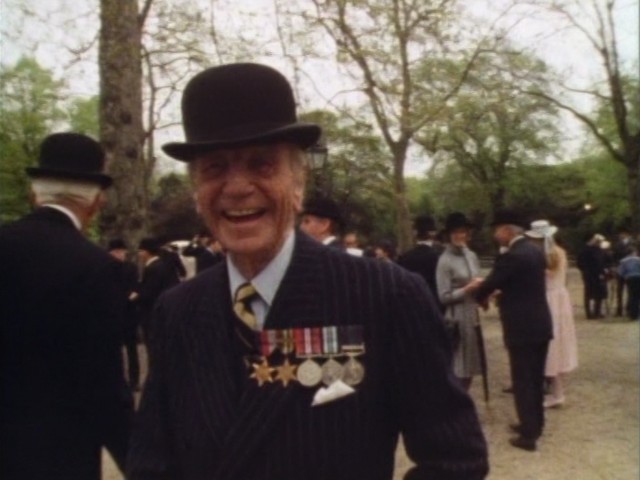
Documentary about Colonel Hilary Hook, formerly of the Indian cavalry and leader of extravagant safaris in Kenya. Hook returned home to England after being evicted from his home in the Kenya Hills, and is finding it hard to readjust to the English way of life. Directed by Molly Dineen.
We take 196 million cups of tea a day. We reach for a cup in a crisis; we break for tea when we can. And the heroines of our favourite brew are the ladies of the tea trolley. Alice, Dolly, Edna and Margaret stroll through the mayhem of money-brokers in the City, down the chic corridors of a West End advertising agency, along the open offices of local government in Yorkshire. They dispense advice and succour, entertainment and good cheer to their thirsty customers. Jack and Daisy, who lost their partners years ago, tea dance their blues away in the Palm Court once a week. WVS ladies tell stirring tales of how a nice cuppa kept us going in the blitz. Tough men on army manoeuvres prepare their own special brew. But over all hangs the threat of the automatic tea dispenser....
A cigarette holder dropped by Queen Mary when she came to tea, a fragment of wallpaper that may have killed Napoleon, a pet chameleon, a book bound in a murderer's skin.... Lucinda Lambton conjures up curiosities from the dark corners of museums and collections throughout the land. With her irrepressible sense of fun, she tells the story of the eccentrics who gathered these treasures.
On the night of 28 June 1944, a Halifax bomber was shot down over Northern France. The navigator, Sergeant John Miller, parachuted out. For nine weeks he was lost in the backwaters of rural France, passed from family to family along the chain of the Resistance. But what really happened to him? Forty years later, following the enigmatic clues in Sergeant Miller's pocket diary, his son Graham decides to retrace his father's journey. He takes a French-speaking friend, Paul Atterbury, to help him on his quest - two Englishmen abroad, picnicking by the roadside, dropping in on a village fete, examining restaurant menus for the cheapest meal in town. The search leads to some strange encounters. Where does Jumel fit into the jigsaw? What has happened to Madame Bouteille, the doctor's wife? And who is Bruno, the mysterious tailor of Grandvilliers...?
An epic tale of pride and passion following competitive leek growers in the north east of England and the event they all dream of winning, the World Open Leek Championships.
Riding the Iron Horse - a roaring, full-throated Harley Davidson - across the open prairie is an American dream. Fifty thousand leather-clad bikers make romance come true as they converge, from all over the States and beyond, on Sturgis, a sleepy farming town in South Dakota. The 48th annual Black Hills Motorcycle Rally brings together weekenders on little Japanese bikes and hard-core, all-American Wild Ones. It's a raucous summer week of racing, drinking, partying and generally raising hell. 'The Sons of Silence' is one of the many bikers' chapters here. The Sons believe in America, freedom, white power, and loyalty to each other. They've got their own chaplain; women are not members, but 'property'. Rebels against convention, they live by their own strict code - 'We are the Sons of Silence until death'.
The public image is glamorous - warm smiles and crisp uniforms, good looks and faraway places. No wonder thousands of hopefuls apply each year to become air stewardesses or stewards. What happens to the few who succeed? Helen MacLeod , from Dunfermline, and Neil Dover , from Durham, both aged 21, are two of the latest batch of 15 trainees to join British Airways. They've hardly ever travelled before. Now there's a demanding six-week course and a lot to learn - how to put out fires and push people down chutes, how to deal with difficult passengers and flirtatious ones. What if there's a hijack - or a heart attack? How much are the duty frees in Japanese yen? If they pass their tests, Helen and Neil can look forward to a nerve-racking fledgling flight on a 747. After that - the excitement, insecurity and hard physical work of being 'waiters in the sky'.
Scarfe's Follies with Bob Geldof, Jane Asher, Terry Jones, Ian McKellen, Robin Bailey, Julian Glover, Marcia Warren, John Bird, John Challis, John Watts, Nellie the elephant and Ivy the camel. Gerald Scarfe records the follies of man in his cartoons. Now he wants to create his own folly. But what are follies - and why did eccentrics build them? Surrounded by high-kicking follies girls and borne by noble beasts, Scarfe sets off on a quest of discovery. He encounters a naughty vicar who built a folly garden for his gypsy girlfriend; a Welshman who burned his own son; a politician who got voters drunk; a man whose house resembles a jungle; and 'Mad Jack' Fuller, who built a steeple overnight to win a wager, and was buried in a pyramid with a bottle of port and a cold chicken. And as all the best follies contained a resident hermit, Scarfe advertises for one in the Times - with startling results.
'We've been told to watch out for pinko, leftist, gay-lib, one earring-wearing teachers....' Mark is a sixth-former at Rugby, a famous public school. It is the setting of Tom Brown's Schooldays. He's one of ten boys and girls from Rugby and ten from a comprehensive school, Ruffwood, who for two weeks change places. Ruffwood is a successful comprehensive in Kirkby, on the edge of Liverpool, where unemployment is high and opportunities are few. Rugby is steeped in tradition and rich in facilities. Parents pay fees of at least £6,600 a year. What will the Merseyside students make of the cadet force, chapel and May ball? How will the public-school pupils react to fish and chips in Kirkby? The boys and girls from Rugby and Ruffwood will glimpse a world that is unknown to them - can the barriers of class and wealth be overcome?
Lucinda Lambton travels along the Great North Road, the backbone of Britain that links London to Edinburgh, discovering many weird and wonderful delights en route.
The story of a remarkable young woman. It's Alison French's wedding day. She's 24 - vivacious, candid, attractive, with a warm smile and a lively sense of humour. Alison, professionally qualified as a youth worker, is marrying Mark John. What makes her wedding different is that she's an athetoid spastic - her body's never still, and she has difficulty with her speech. Seven years ago, 40 Minutes made an acclaimed film about Alison, telling of her bid to gain independence in the able-bodied world. Tonight's follow-up is a passionate love story. But in marrying the man she loves, Alison has to leave her family in Watford, set up a new home in South Wales, and adapt to being a clergyman's wife. Her heart is still set on finding an independent job. The harsh reality is that despite her skills and rare qualities, she may face rejection. But Alison doesn't give up easily...
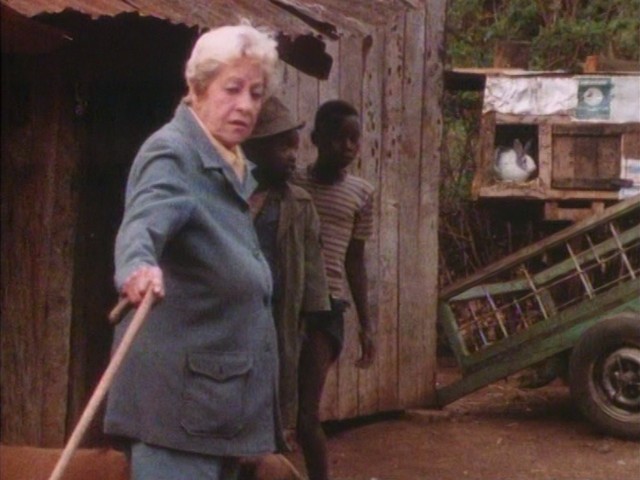
Molly Dineen returns to Kenya for this documentary, centred around the home of Sylvia Richardson. She builds a complex and uncompromising portrait of an unswerving stalwart of British colonialism.
It's February in Eastbourne - a cruel month. Some hotel residents on Grand Parade are being shunted upstairs to new rooms they do not really like. Seaside hotels now chase the conference trade. Permanent residents, once needed out of season, are no longer so welcome. Mrs Sybil Bloom, 86, is unhappy with her move, so is Mrs Muriel McNab, 85. But the two widows have little choice - they move up or they move out, as their hotel gets a £20 million face-lift. Mrs McNab has lived at the Burlington for 17 years and wants to stay. So does Mrs Bloom; "Not many hotels take residents these days, so where would I go?" Only a few years ago there were more than 100 residents on Grand Parade. Now there are just 30 - a dauntless breed of touching, frail, cheerful people, who simply wish to see out their days in peace on this select seafront strip.
An extraordinary story of heartache and humour, of friendship and maternal love. Did two women in a maternity unit somehow end up with each other's baby girl?
Lucinda Lambton has photographed houses for 27 years. She conducts a personal and enthusiastic tour around her favourites - some of Britain's oddest, most individual and delightful homes. Lucinda's travels take her to a Hollywood hacienda in Derbyshire, created for a man who banished straight lines; a clairvoyant's bijou residence in the air; a Gothic castle now being built by a ruralist in deepest Cornwall; a haunted Victorian hotchpotch of a place north of the Humber, where the tiles don't match; and a circular confection of great charm in Devon, created by the Misses Parminter.
Darren Lillywhite was 17, mischievous and high-spirited. He and his mates were a lively lot, always getting into scrapes around the village of Cranleigh, where they grew up. Darren had owned his prized Vauxhall Astra for just a few weeks. One August evening in 1987 he drove it into a roundabout and was thrown from the car. Now he is paralysed from the neck down and can do nothing for himself. Darren has been at Stoke Mandeville Hospital for ten months, but his family is determined to get him back home. Terry and Marilyn Lillywhite have built a special extension to their house. If Darren makes it, his family, neighbours and friends will all be joining in the celebration. No one can help liking Darren. 'I don't feel bitter about it at all,' he says. 'It's like being born again, really....'
A journey by Intercity into the world of the supernatural. Do you believe in ghosts? Helen McCormick does. She found an ancient crucifix in her cellar - and then saw a medieval monk walk past her kitchen window. Ambulanceman Ken Lobley rescued his aunt after a warning from an apparition. Nichola Thompson, aged 13, was reading, looked up, and saw her grandmother - wearing the pink shroud she'd been buried in two years earlier. Rev Jack Richardson investigates spooky Harnham Hall in Northumberland. He blesses the earthly remains of Kate Babington, who died a prisoner at Harnham in 1670. Eddie Burks, a 'clairsentient', is summoned to an RAF base to contact the ghost of an airman. Eerily, he describes how the man died and why he returns. And four nurses spend the night in 'the most haunted house in Britain' - with strange tales to tell the following morning....
It's said that 2,000 dogs and 4,000 cats are destroyed in Britain every day. Celia Hammond was a top fashion model. Now she's so furious about the destruction of healthy animals that she's given up her career, even her personal life, to rescue as many strays as she can. She prowls the wastelands and alleyways of London to save frightened, injured and lost cats. Her ultimate aim is to set up her own low-cost spaying and neutering clinics.
A real life soap opera is unfolding in Cardross Street, West London. A Royal Ballet star, a man who owns a share in a race horse, and a peer's daughter now live side by side with old folk who have rented their houses all their lives. Once the street was filled with families. Now it's being taken over and tarted up by the young rich with no children. 'Funeral today - skip tomorrow' is how the locals describe what's happening. Had they been able to afford it, the old timers could have bought their homes for £200. Now unmodernised two-up two-downs with outside loos are snapped up at £150,000. 'For the old people the street is a way of life,' says the Hon Henrietta Roper-Curzon . 'For us it is just a transitory thing. When they leave it's in a hearse. We leave in the removal van'. With John Pitman.
An insight into the first few months of Britain's first purpose-built AIDS hospice. London Lighthouse is an experiment. The building is striking. The approach to nursing is radical. The project could provide a model for the health care of the future. Beatty King, 26, is one of 15 nurses working at Lighthouse. On night shift, she spends the small hours gently negotiating with Colin, who's desperate to smoke, and sitting with Christopher, who is close to death. The patients appreciate having as much say as possible in how they are looked after. But as relationships develop, emotional pressures increase. Beatty admits, 'I don't think I realised what I was letting myself in for....'.
This acclaimed observational documentary by BAFTA award winning director Molly Dineen is set at London’s Angel tube station in 1989, three years before its desperately needed renovation. The programme provides a humorous account of 48 hours in the life of the tube station, from the daily round of fraught commuters, overburdened lifts and cancelled trains to the nightly activities when 'fluffers', women who clean human hair and rubbish of the tracks to avoid a fire hazard and ‘the Permanent Way’, gangs of men who work with pickaxes in almost pitch-black conditions to renovate parts of the track, spring into action to prepare the line for the following day.
At least one in every five children in Britain suffer from bullying. In our schools the problem is worse than anywhere else in Europe. 40 Minutes reveals what's really going on in the playground.
The Archers is the longest-running soap opera in the world. The radio drama has been broadcast nationally since 1951 and has now survived for more than 10,000 episodes. But does Ambridge exist? How real is Eddie Grundy? What was the truth behind Brian Aldridge's nasty accident? And how was a furry white rodent involved?
Ten of the most dangerous and disruptive men in the prison system have been brought together in an experimental unit at Hull Jail. A new softly-softly regime is being tested on inmates like Fred Low, who is serving three life sentences - one for killing a fellow prisoner - and Patrick Mackay, serving five life sentences for manslaughter and robbery. 40 Minutes gained access to the unit as the prisoners started to reveal themselves to the hand-picked staff, and as conflicts began. The most serious clash was over the only woman working full time in the unit, and it involved David McAllister, serving 19 years for armed robbery and assault, who later escaped from the unit and was on the run for five days. This film tells the story of the most controversial unit in our prisons.
In New Jersey, USA, a team of cops and scientists is 'busting' polluters. For the first time a film crew has been given total access to their operations. 40 Minutes follows the trail - the surveillance. the 'sting', the raid. Whether it's one small operator dumping chemicals on the street or the president of a multi-million-dollar company caught polluting a river - both are likely to face serious criminal charges. In New Jersey, they believe only tough action will deter dumpers. Is there a lesson for us in Britain?
Two children who feel sure they died terrible deaths and have been born again tell their extraordinary stories. Nicola, aged 12, lives in Keighley, Yorkshire, near to the railway tracks where she played in the 19th century in another life. Then, she says, she was a boy. Parish records suggest that it isn't just a childhood fantasy. Titu, aged 6, lives in north India in the shadow of the Taj Mahal. His is a violent story. He alleges he was gunned down by a murderer. Another vivid imagination? The radio shop he ran still exists, and his widow is still alive. When he mentions buried gold, it seems to jog her memory...
Malika Shawa is an old girl of Cheltenham Ladies College. She's also a Palestinian aristocrat, who owns the only hotel in the Gaza Strip. In the refugee camp next door, the Palestinian intifada - an uprising against Israeli occupation - began three years ago this week. Today, Malika's guests are a strange collection of journalists, diplomats and foreigners on fact-finding tours. For them, her hotel is 'an oasis from the filth, smells and violence that surrounds it'.
'I was born and brought up in Britain. I was 8 years old when I was circumcised. I really thought I was going to die, because of the pain, having no anaesthetic. You have a lady holding your mouth so you cannot scream, you have two ladies on your chest and the other two holding the legs.'. Seven years ago, 40 Minutes' first film on female circumcision led to the law which banned it in this country. Today's film reveals that the practice of genital mutilation of young girls is still flourishing in Britain today.
Five young Russian survivors of the Soviet Union's worst rail disaster arrive in Manchester for medical treatment. Badly burned in the explosion in 1989, they hope plastic surgeon Stewart Watson can help. Bewildered, without a word of English, they face major surgery and the unfamiliar west. Immediately they're the centre of attraction, with a press conference on their first day in hospital and an invitation to Downing Street before they leave.
For 47 years Alec Krawczynski has lived in Scotland. He is known as Alec the Pole. But his real name is not Krawczynski and he has never been to Poland. He came from the Ukraine and for nearly 50 years has kept a deadly secret. Now, as the Ukraine reaches out for independence, he discovers members of his family are still alive. He returns to the Ukraine to discover if his country and family are ready to forgive him for being, in his own words, a traitor.
A rape in the Irish village of Bray divides the community. Local man Gerry is sent to prison, separated from his wife Saundra and his children. But the rape victim is also isolated by her neighbours. "Nobody believed her. In Irish society it's all black and white, virgin or whore." Fifteen months later, Gerry's appeal draws near, raising new hopes in Saundra and old conflicts in the small world torn apart by the crime.
Forget Backdraft or London's Burning, two-thirds of England's fire stations are operated by the butcher, the baker and the software maker. One such fire station is Windermere Fire Station, where Station Officer Doug Harris (a Post Office mechanic by trade) and his crew - which includes a B&B owner, a fitter and turner, and a dustman - must balance the demands of their ordinary working lives with their role as part-time firefighters. Mark Frith's charming observational documentary spends time with the Windermere crew, as they diligently respond to false alarm after false alarm, work their day jobs, and train hard to be ready for a serious incident.
During the property boom, big profits could be made buying and selling London hotels used by councils to house the homeless. Now property prices have dropped and councils are cutting back on bed and breakfast bills. 40 Minutes takes a closer look at this notoriously secretive world.
An adventure story by international Emmy award-winning film-maker Nigel Evans. Into the jungles of a small Pacific island, Dr Danforth Artie Bookout leads his team of intrepid Texans to search for an aircraft and the body of Weyland Bennett, a "home-town boy" missing in action 50 years ago. Deep in the bush sits Chief Jean Marc waiting for his Texan pay packet to lumber into view. And two days' walk behind the Texan strides a local explorer who knows the secrets of Dr Dan's past.
Capturing escaped pythons, confiscating pet cougars or wrestling with exotic crocodiles - it's all in a day's work for Miami specialist police officer Lieutenant Kat Kelley. The locals are crazy about owning flamboyant pets and many of these exotic animals have escaped and multiplied over the years, threatening both people and native wildlife. Kelley is on call 24 hours a day and never knows what she will have to face. "We're fighting a losing battle here. Basically, nature is out of control."
At 34, 5ft 2ins tall and weighing 16 stone, Annette is desperate to lose weight. She has been told the only permanent solution is a stomach stapling operation. The surgeon says that with a specially adapted staple gun he can reduce the size of Annette's stomach to the length of a teaspoon. And that would mean she would only ever be able to eat tiny portions of food. Unable to bear her fat any longer, and with a family history of diabetes and heart disease, Annette feels she has nothing to lose. Meanwhile her friend Kath, who reduced from 19 to seven stone after her operation, is now back to a size 22 and about to enter hospital for a fourth operation.
What has happened to Essex Man in the 90's? Martin Smith and his girlfriend Mandy epitomise many young people whose champagne lifestyle has suffered in the recession-hit 90's. How do they feel about the country now?
Ten years after Package Tour (1983), we head back to Benidorm from the North East of England, with a group of nine lads crammed into an apartment made for four.
What has happened to Essex Man in the 90's? Martin Smith and his girlfriend Mandy epitomise many young people whose champagne lifestyle has suffered in the recession-hit 90's. How do they feel about the country now?
Documentary following the career of the comedian Ernie Wise after the death in 1984 of his comedy partner Eric Morecambe. It charted the current work of the comedian who, since the death of his partner, had made West End appearances in The Mystery of Edwin Drood and concentrated largely on pantomime work. His autobiography, entitled Still On My Way To Hollywood, is referenced throughout the programme. Despite having the full co-operation of the subject, the programme has been criticised for focussing on him in a negative way, portraying a somewhat tragic figure and, in one section, memorably sees him reminiscing with a view of Eric Morecambe from one of their television programmes in the background. Wise is known to have been unhappy with the outcome of the broadcast programme, and it is notable for being his last major televised work prior to his death in 1999 from heart problems.
Independence, self-reliance, confidence. These are some of the qualities that the traditional single-sex English boarding school gives the children in its care. 40 Minutes follows some 8-year-old boys off to different boarding schools for the first time. Their parents and headmasters are confident that they are doing the right thing. But some ex-boarders are not so sure. These men feel that the experience of boarding at a young age was damaging.
This film looks at a theatre group who specialise in prison remedial work. By turning hardened criminals into actors, they challenge them to reveal human emotion from behind their masks of hardness.
Edward Mirzoeff, former BBC executive documentary producer and series editor of flagship series 40 Minutes, looks back on his time at the helm of one of the most innovative and exciting strands of documentary-making ever to appear on British television. Mirzoeff recollects how the series came into being and how the format grew from observational storytelling into an important time capsule, capturing and documenting the everyday lives of ordinary British citizens like never before. He talks specifically about some of the standout films from the series, and the impact they had on him, the viewers and documentary film-making for years to come.
Interview with Molly Dineen on the making of Home from the Hill and My African Farm, featuring editor Edward Roberts.
Unseen Footage from the 1989 40 Minutes documentary 'Heart of the Angel' with an introduction and commentary by Molly Dineen.